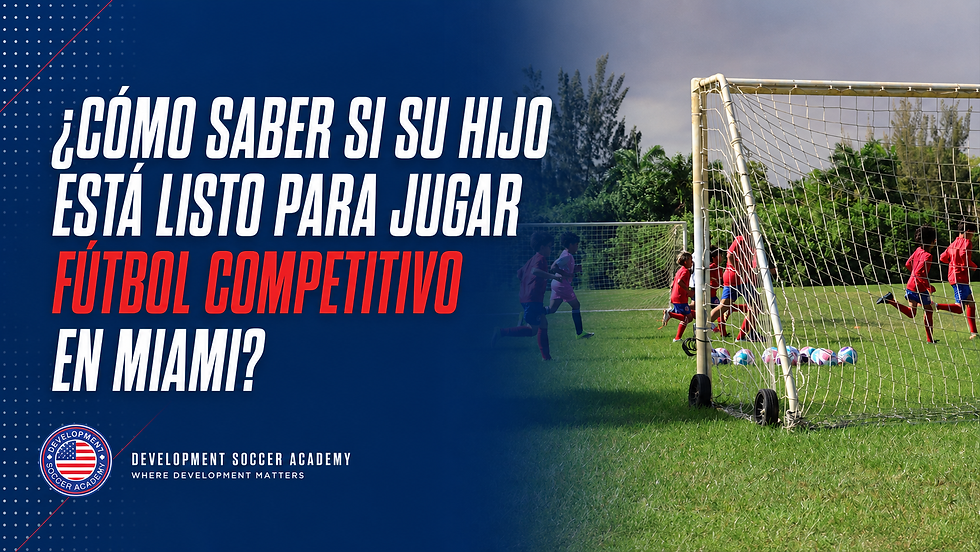
Recreational vs. Competitive Youth Soccer in Miami: Which Is Right for Your Child?

Choosing the right soccer program can be challenging for parents, especially when a child is still discovering the sport or beginning to show greater interest and ability. Families often wonder whether their child should remain in a recreational environment or move into competitive soccer.
The answer should not be based only on age, athletic ability, or the number of goals a child scores. The right environment depends on the player’s experience, confidence, motivation, emotional maturity, availability, and willingness to accept a greater level of commitment.
Understanding the differences between recreational and competitive youth soccer in Miami can help parents make a decision that supports both their child’s development and enjoyment of the game.

What Is Recreational Youth Soccer?
Recreational soccer is generally designed to introduce children to the game in a welcoming, lower-pressure environment. The primary objectives are participation, enjoyment, physical activity, and learning fundamental skills.
For beginners, this type of program can provide an important foundation. Children receive opportunities to become comfortable with the ball, understand basic rules, interact with teammates, and develop coordination without immediately facing the demands of competitive team soccer.
A recreational or introductory development program may be appropriate for children who:
Are playing organized soccer for the first time
Are still learning basic techniques and rules
Want to participate without a demanding schedule
Need time to build confidence around other players
Enjoy soccer but are not yet interested in regular competition
Participate in several sports or activities during the year
At Development Soccer Academy, our Pre-Academy soccer classes provide an introductory pathway for beginners and developing players. These classes focus on ball mastery, dribbling, passing, receiving, shooting, movement, coordination, teamwork, and confidence.
Previous playing experience is not required, allowing each child to begin from an appropriate starting point.
What Is Competitive Youth Soccer?
Competitive soccer introduces players to a more structured team environment. Training becomes more demanding, attendance carries greater importance, and players must begin applying their skills during league games and other competitive situations.
The purpose of competitive soccer should not be limited to winning. When properly organized, competition becomes an important developmental tool. Games allow coaches to evaluate how players make decisions, respond to pressure, communicate with teammates, manage mistakes, and apply what they have learned during training.
Competitive players are normally expected to demonstrate:
Consistent attendance and punctuality
A positive attitude toward coaching
A willingness to work and improve
Greater focus during training
Respect for teammates, opponents, coaches, and officials
Emotional resilience after mistakes or difficult results
Availability for scheduled games and team activities
Competitive soccer also requires more commitment from the family. Parents may need to organize their schedules around multiple weekly practices, weekend games, travel, uniforms, league responsibilities, and occasional tournaments.
For the right child, this structure can create an exciting environment that strengthens technical ability, tactical understanding, discipline, responsibility, and confidence.
Recreational vs. Competitive Soccer in Miami: The Main Differences
Although every organization operates differently, parents will usually notice several important distinctions between introductory and competitive soccer programs.
Training expectations
Recreational and beginner programs normally emphasize participation, basic skill development, and enjoyment. Competitive teams train with greater intensity and spend more time working on game situations, team principles, positional understanding, and decision-making under pressure.
Attendance and commitment
Introductory programs may provide families with more flexibility. Competitive teams depend on consistent attendance because coaches must prepare the entire group to perform together.
When one player misses training regularly, it can affect not only that player’s progress but also the preparation of teammates.
Player placement
Beginner programs often accept children without a formal evaluation. Competitive programs generally require a tryout or assessment to determine whether the player is ready for the technical, tactical, physical, and psychological demands of the team.
An evaluation should not simply determine whether a child is “good” or “not good.” Its purpose is to identify the environment in which the player can be appropriately challenged and supported.
Games and results
Recreational soccer prioritizes participation and learning. Competitive soccer introduces standings, league games, stronger opponents, and greater performance expectations.
Results become part of the experience, but they should never become more important than long-term player development.
Family responsibilities
Competitive soccer requires greater coordination from parents. Families should understand the training schedule, game expectations, financial commitments, communication policies, and attendance requirements before accepting a team position.
How Can Parents Know When a Child Is Ready?
A child does not need to be the most talented player in a recreational program before moving forward. Natural ability can be helpful, but readiness also includes behavior, motivation, consistency, and emotional maturity.
Your child may be prepared for competitive soccer if they:
Frequently ask to train or play outside scheduled sessions
Remain focused during more demanding activities
Respond positively to coaching and correction
Enjoy competing against players of similar or greater ability
Become bored or insufficiently challenged in a beginner environment
Show responsibility toward teammates and training
Recover constructively after mistakes
Want to improve rather than simply attend
Are comfortable making a stronger commitment to the sport
Parents should also listen carefully to the child. A player may have the ability to compete but not yet have the interest or emotional readiness. Moving too quickly can create unnecessary pressure, while waiting too long in an environment that is no longer challenging can slow progress and reduce motivation.
The ideal next step provides challenge without overwhelming the player.
Does Competitive Soccer Always Mean Better Development?
Not necessarily.
A competitive label does not automatically guarantee quality coaching or appropriate development. A child can participate in many games and tournaments without receiving enough instruction, meaningful playing experiences, or individual support.
Parents should look beyond uniforms, league names, rankings, and trophies. A strong competitive program should provide:
Qualified and attentive coaches
Age-appropriate training
A clear player-development methodology
Frequent contact with the ball
Game-realistic exercises
Individual feedback
Opportunities to make decisions
Appropriate competition
A respectful and organized environment
A pathway for continued progression
Children need to be challenged, but they must also be allowed to make mistakes. Fear of failure can prevent young players from becoming creative, confident, and independent on the field.
Should Winning Be the Priority?
Winning is a natural and valuable part of competition. Players should learn to compete with determination and take pride in representing their team. However, youth soccer results must be viewed in the correct context.
A team can win a game while displaying poor decision-making and limited development. A team can also lose against a strong opponent while demonstrating courage, improvement, teamwork, and a better understanding of the game.
Quality coaches use both victories and defeats as learning opportunities. The objective is to develop players who can perform successfully over time, not simply collect short-term results at young ages.
At DSA, competition supports development. It does not replace it.
Can a Child Move From Recreational to Competitive Soccer?
Yes. Player development is a process, and children progress at different rates.
Some players begin in introductory classes and quickly demonstrate that they need a stronger challenge. Others may require more time to develop coordination, technique, confidence, concentration, or understanding of the game.
Neither pathway should be viewed negatively. Starting in a beginner program gives players time to establish the foundation they will need later. Moving into competitive soccer should happen when the coaching staff and family believe the player is ready for the next level of responsibility and challenge.
DSA provides a structured pathway that allows players to progress from Pre-Academy classes to Academy Competitive Teams and eventually to Premier Competitive Teams, when appropriate.
Choosing the Right DSA Program
Development Soccer Academy offers different programs for players at various stages of their soccer journey.
Pre-Academy
The Pre-Academy program is designed for beginners and early-stage players who need to develop fundamental skills, coordination, confidence, and enjoyment. No competitive tryout is required.
Academy Competitive Teams
Academy Teams introduce qualified players to organized team training and local competition. This level helps bridge the gap between introductory classes and a more demanding competitive environment.
Premier Competitive Teams
Premier Teams are intended for players prepared for advanced training, stronger competition, league participation, and selected tournaments. Players must demonstrate the appropriate ability, attitude, commitment, and readiness.
The goal is not to place every child at the highest available level. It is to place each child in the environment that offers the best opportunity to learn, improve, and remain motivated.
Frequently Asked Questions
What age should a child begin competitive soccer?
There is no perfect age for every child. Readiness should be based on ability, interest, maturity, commitment, and comfort in a team environment rather than age alone.
Does my child need previous experience to join DSA?
No. Beginners can start in the Pre-Academy program without previous experience. Players interested in Academy or Premier competition must complete an evaluation for proper placement.
Can my child be evaluated if I am unsure about the appropriate level?
Yes. An evaluation allows the coaching staff to observe the player and recommend the most suitable available program.
Is recreational soccer only for beginners?
Not always. Some children prefer a lower-commitment environment even after developing basic skills. The appropriate choice depends on the child’s goals, schedule, and interest in competition.
Can a competitive player return to a less demanding program?
Yes. A player’s needs and family circumstances can change. The priority should always be finding an environment that supports healthy, consistent participation.
Find the Right Soccer Pathway for Your Child
The decision between recreational and competitive youth soccer should not be rushed or influenced only by outside pressure. Parents should consider where their child is today and which environment will provide the appropriate balance of enjoyment, instruction, challenge, and responsibility.
At Development Soccer Academy, we evaluate each player as an individual. Our objective is to help children enter the program that best matches their current developmental stage while providing a clear pathway for future progression.
To learn which DSA program is right for your child, contact Development Soccer Academy to schedule a free trial class or player evaluation.
Development Soccer Academy — Where Development Matters.